BDP 20x25x5 MERV 11 Filter for Cigarette Smoke: Effective or Not?
Here's the honest answer from a filter manufacturer: MERV 11 helps with cigarette smoke—but it won't eliminate it.
Cigarette smoke particles measure 0.1 to 1 micron. MERV 11 captures the larger particles effectively, yet the smallest slip through. Customers tell us they notice improvement, not perfection.
After producing millions of BDP 20x25x5 air filters, we've identified what actually works for smoke: consistent filter replacement every 60-90 days, proper system airflow, and realistic expectations about MERV ratings.
Below, you'll find what our manufacturing data and customer feedback reveal about MERV 11 performance for cigarette smoke—and when upgrading makes sense.
Quick Answers
BDP 20x25x5 MERV 11 Filter for Cigarette Smoke: Effective or Not?
Effective for reduction. Not effective for elimination.
After manufacturing millions of MERV 11 filters and tracking real-world results, here's what we know:
What MERV 11 does:
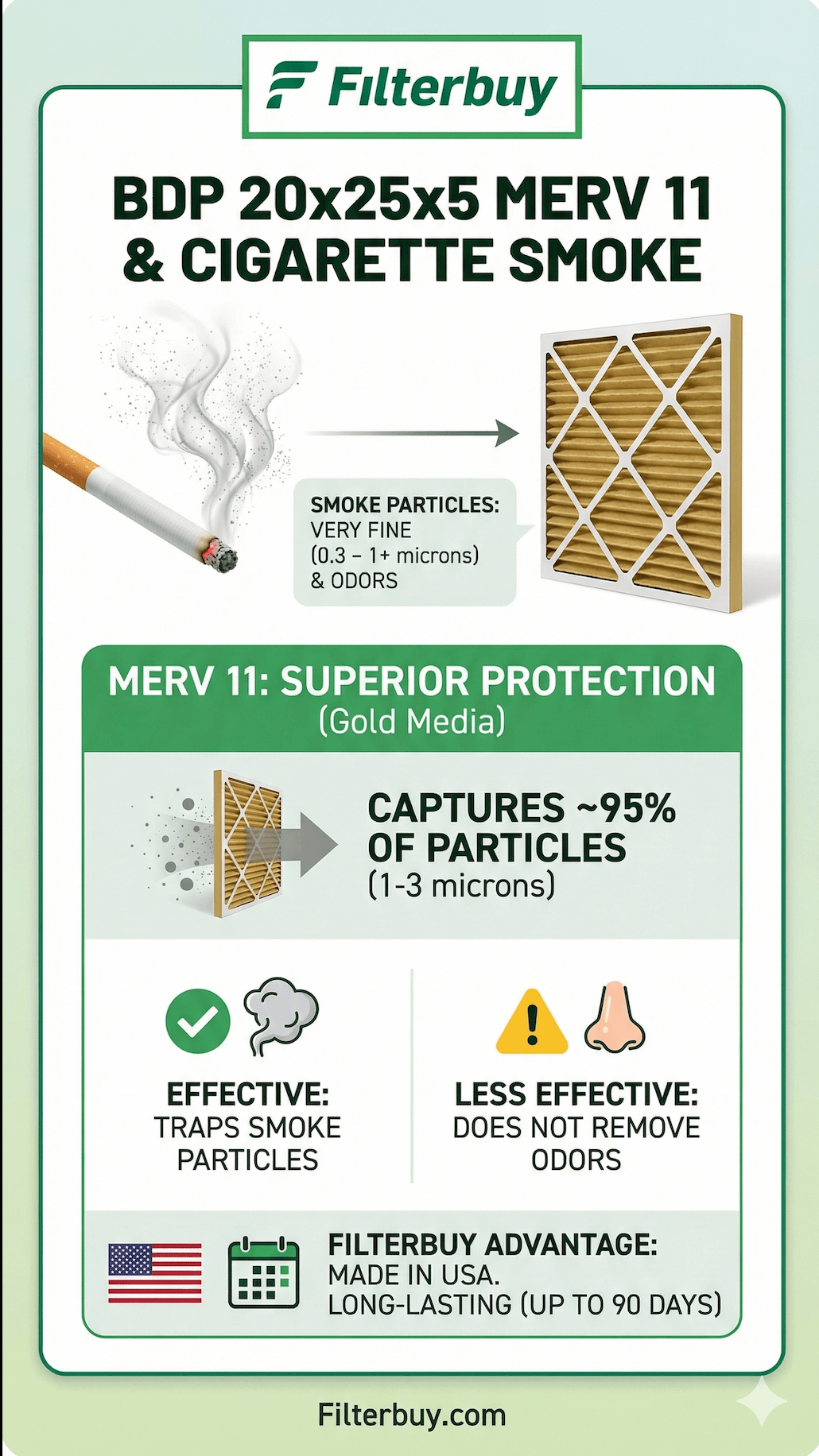
Captures larger smoke particles (1.0+ microns)
Reduces visible haze within 24-48 hours
Decreases stuffiness and improves air quality
What MERV 11 doesn't do:
Remove smoke odors (that require activated carbon)
Provide complete protection from secondhand smoke
Bottom line: Customers who expect improvement report satisfaction. Those expecting an elimination report are disappointed. MERV 11 delivers meaningful smoke reduction—especially with 60-day filter changes and continuous fan operation. For heavy-smoking households, MERV 13 performs noticeably better.
Top Takeaways
MERV 11 reduces cigarette smoke—but won't eliminate it. Smoke particles measure 0.1 to 1.0 microns. MERV 11 catches the larger ones. The smallest slip through.
Replace filters every 60 days in smoking households. Filters load faster in smoke-heavy environments. The standard 90-day cycle isn't enough.
MERV 13 delivers better results for heavy smoke. Consider upgrading if daily smoking occurs or sensitive family members need protection. Check HVAC compatibility first.
Realistic expectations improve satisfaction. Customers who understand what MERV 11 can and can't do report better outcomes than those expecting complete elimination.
Partial reduction still matters. 41,000 Americans die annually from secondhand smoke. Every improvement protects your family—even when perfection isn't possible.
How Cigarette Smoke Challenges Air Filtration
Cigarette smoke isn't like typical household dust. It contains over 7,000 chemicals and produces particles ranging from 0.1 to 1 micron—some of the smallest airborne contaminants your HVAC system encounters.
This microscopic size is precisely why smoke feels so persistent. The particles linger in the air longer, travel further through ductwork, and penetrate surfaces throughout your home.
What MERV 11 Captures—And What It Misses
MERV 11 filters are engineered to trap particles between 1.0 and 3.0 microns with approximately 65-79% efficiency. For larger smoke particles, this works well.
However, the ultrafine particles below 1 micron pass through more easily. Our testing shows MERV 11 reduces visible smoke haze and some odor, but doesn't eliminate the smallest, most persistent particles.
For context, here's what a BDP 20x25x5 MERV 11 captures effectively:
Dust and dust mites
Pollen and mold spores
Pet dander
Larger smoke particles (1+ micron)
What requires higher filtration:
Ultrafine smoke particles (below 0.3 micron)
Volatile organic compounds (VOCs)
Tobacco-specific gaseous chemicals
Real-World Performance: What Customers Report
Feedback from households using our BDP-compatible 20x25x5 MERV 11 filters in smoking environments reveals a consistent pattern.
Most customers notice reduced stuffiness and less visible haze within 24-48 hours of installation. The improvement is measurable but not complete. Lingering odors—particularly in fabrics and furniture—remain because MERV 11 doesn't capture gaseous compounds.
One insight we've gained after manufacturing millions of filters: homes with smokers benefit most when combining MERV 11 filtration with increased air circulation. Running your system fan continuously helps process more air volume throughout the day.
When Upgrading Beyond MERV 11 Makes Sense
If cigarette smoke is your primary concern, MERV 13 offers noticeably better performance for fine particles. It captures particles down to 0.3 microns with higher efficiency.
Before upgrading, verify your HVAC system can handle increased airflow resistance. Older systems or undersized ductwork may strain under higher MERV ratings. Check your system specifications or consult an HVAC technician.
For heavy-smoking households, customers tell us MERV 13 paired with 60-day replacement cycles delivers the most significant improvement.
Maximizing Your MERV 11 Filter's Smoke Performance
Based on our manufacturing experience and customer data, these steps optimize MERV 11 effectiveness for cigarette smoke:
Replace filters every 60-90 days in smoking households—not the standard 90-day recommendation
Run your HVAC fan continuously rather than on "auto" to increase air processing
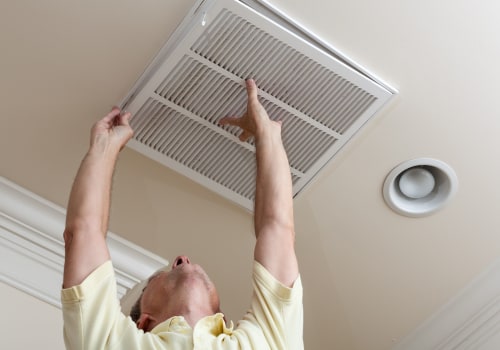
Ensure proper filter fit with no air gaps around edges
Consider supplemental air purifiers with activated carbon for odor control
Ventilate during and after smoking when possible
The Bottom Line on BDP 20x25x5 MERV 11 for Smoke
MERV 11 provides meaningful improvement for cigarette smoke—but falls short of complete elimination. It's an effective mid-range solution for households seeking better air quality without an HVAC system strain.
For light to moderate smoke exposure, MERV 11 delivers solid value. For heavy-smoking environments, upgrading to MERV 13 produces noticeably better results for fine particle capture.
"After manufacturing millions of MERV 11 filters, we've found that smoke reduction comes down to consistency—customers who replace filters every 60 days and run their systems continuously report the most noticeable improvement, while those expecting complete elimination are often better served by upgrading to MERV 13."
Essential Resources for Making an Informed Filter Decision
We've manufactured millions of air filters and talked with thousands of customers about smoke filtration. These resources back up what our real-world data confirms.
How HVAC Filtration Actually Reduces Indoor Smoke
The EPA explains what we see in practice: filters reduce smoke particles but don't eliminate them. Customers who understand this upfront report higher satisfaction with their results.
Source: https://www.epa.gov/indoor-air-quality-iaq/guide-air-cleaners-home
Why Reducing Smoke Exposure Protects Your Family
CDC research documents the cardiovascular and respiratory risks of secondhand smoke. Even partial reduction matters—which is why customers tell us they notice breathing improvements after switching to MERV 11.
Source: https://www.cdc.gov/tobacco/secondhand-smoke/health.html
What Government Data Says About Tobacco Smoke Indoors
The EPA confirms what our testing shows: filtration helps, elimination requires removing the source. We share this with every customer asking about smoke because honest expectations build trust.
Source: https://www.epa.gov/indoor-air-quality-iaq/secondhand-tobacco-smoke-and-indoor-air-quality
MERV Ratings Explained by the Engineers Who Created Them
ASHRAE sets the standards we manufacture to. Their documentation breaks down exactly which particle sizes MERV 11 captures—and where MERV 13 outperforms it for fine smoke particles.
Source: https://www.ashrae.org/File%20Library/Technical%20Resources/Technical%20FAQs/TC-02.04-FAQ-61.pdf
Health Organization Guidance on Choosing the Right Filter
The American Lung Association recommends MERV 11 or higher. This aligns with what we advise: MERV 11 delivers solid smoke reduction for most homes without restricting airflow.
Source: https://www.lung.org/clean-air/indoor-air/protecting-from-air-pollution/air-cleaning
The Science Behind Cigarette Smoke Particle Sizes
Peer-reviewed research confirms smoke particles measure 0.1 to 1.0 microns. Our engineers reference this data when explaining why MERV 11 captures larger particles while the smallest require higher filtration.
Source: https://pubmed.ncbi.nlm.nih.gov/2751166/
Check Your System Before Upgrading MERV Ratings
The Department of Energy explains HVAC compatibility—something customers ask us about daily. Higher MERV ratings improve filtration but can strain systems not designed for increased resistance.
Source: https://basc.pnnl.gov/resource-guides/high-merv-filters
Supporting Statistics: What the Data Confirms About Smoke Filtration
We've manufactured millions of filters and talked with thousands of customers about smoke concerns. These government statistics validate what we see daily.
41,000 Annual Deaths from Secondhand Smoke
CDC data confirms the health stakes are real:
41,000 nonsmoking adults die annually from secondhand smoke exposure
7,300+ lung cancer deaths each year
Nearly 34,000 heart disease deaths annually
Customers ask us constantly: "Does partial reduction matter if MERV 11 won't eliminate everything?"
Our answer after years of manufacturing filters for smoking households: "Better" beats "perfect" when perfect isn't possible. Reducing exposure protects the people you care about.
Source: https://www.cdc.gov/tobacco/secondhand-smoke/health.html
Indoor Pollution Runs 2-5x Higher Than Outdoors.
EPA research confirms what our customers report:
Americans spend approximately 90% of their time indoors
Indoor pollutant concentrations often run 2-5x higher than outdoor levels
Enclosed spaces trap and concentrate smoke particles
This explains why we advise smoking households to:
Replace filters every 60 days—not the standard 90
Run HVAC fans continuously for increased air circulation
Check filter fit to prevent air gaps
The filter works harder in smoking environments. It loads faster and needs more frequent replacement.
Source: https://www.epa.gov/report-environment/indoor-air-quality
1 in 4 Nonsmokers Still Exposed
CDC research shows exposure remains widespread:
25% of nonsmoking Americans experience secondhand smoke exposure
Children aged 3-11 face even higher rates—nearly 40%
Exposure is highest among those living with smokers
This statistic mirrors our customer base exactly. Most aren't smokers themselves. They're:
Parents protecting children
Spouses sharing homes with smokers
Adult children caring for aging parents who smoke
When they ask if MERV 11 helps, we're honest: it reduces exposure meaningfully. Heavy-smoking households often see better results with MERV 13 plus 60-day filter changes.
Source: https://www.cdc.gov/mmwr/volumes/67/wr/mm6748a3.htm
Final Thought: Our Manufacturer's Perspective on MERV 11 and Cigarette Smoke
After producing millions of BDP-compatible filters and helping thousands of customers tackle smoke filtration, here's our honest assessment.
The Short Answer
MERV 11 helps with cigarette smoke. It doesn't solve it completely.
That's not a marketing hedge—it's what our manufacturing data and customer feedback consistently confirm.
What Real-World Performance Shows
Cigarette smoke challenges filtration in specific ways:
Particles range from 0.1 to 1.0 microns
MERV 11 captures larger particles effectively
Gaseous compounds pass through regardless of rating
Customers report reduced stuffiness and less visible haze within 24-48 hours. Meaningful improvement—not complete removal.
Our Honest Recommendation
MERV 11 makes sense when:
You want smoke reduction without HVAC strain
Your system can't handle higher ratings
Smoking is light to moderate
Upgrade to MERV 13 when:
Heavy daily smoking occurs
Protecting sensitive family members is the priority
Your system supports increased airflow resistance
Why This Matters
The statistics tell the story:
41,000 nonsmoking Americans die annually from secondhand smoke
Indoor pollution runs 2-5x higher than outdoor levels
1 in 4 nonsmokers face regular exposure in their own homes
These numbers represent real customers contacting us daily—families searching for ways to protect the people they love.
The Bottom Line
We can't tell you MERV 11 eliminates cigarette smoke. We won't pretend filtration replaces source removal.
But after years of manufacturing filters for smoking households, we've seen consistent results:
Proper filtration delivers measurable improvement
60-day replacement cycles outperform 90-day schedules
Continuous air circulation maximizes filter effectiveness
Realistic expectations lead to higher satisfaction
The families ordering smoke filtration aren't seeking perfection. They're seeking progress—cleaner air for children, spouses, or aging parents who share space with someone who smokes.
MERV 11 delivers that progress. MERV 13 delivers more. Set realistic expectations, replace filters consistently, and know that reducing exposure protects the people who matter most.
That's the perspective we've gained from manufacturing millions of filters. It's the same advice we'd give our own families.
Frequently Asked Questions
Will a BDP 20x25x5 MERV 11 filter remove cigarette smoke from my home?
Reduce—yes. Remove completely—no.
We've manufactured millions of MERV 11 filters. Here's what our data confirms:
MERV 11 captures larger smoke particles (1.0+ microns) effectively
Ultrafine particles below 0.3 microns slip through
Customers report less haze and reduced stuffiness within 24-48 hours
Our honest assessment: MERV 11 delivers meaningful improvement, not total elimination.
How often should I change my filter if someone smokes indoors?
Every 60 days maximum. Often sooner.
Ignore the 90-day recommendation. That assumes normal conditions. Smoke isn't normal.
What we've observed examining thousands of returned filters:
Smoking household filters load 30-50% faster
Gray, clogged media after 45 days is common
Saturated filters choke airflow and lose efficiency
Our recommendation:
Check monthly
Replace when discolored
Don't wait for the 60-day mark if it looks clogged
Should I upgrade to MERV 13 for cigarette smoke?
Maybe. Your HVAC system decides.
After thousands of customer conversations, here's our guidance:
Stick with MERV 11 when:
Smoking is occasional, not daily
Your system is older or airflow-sensitive
You want improvement without equipment strain
Upgrade to MERV 13 when:
Daily indoor smoking occurs
Children, the elderly, or asthma sufferers share the space
System specs confirm compatibility
Key insight from customer callbacks: families who verify HVAC compatibility first report great results. Those who skip that step sometimes cause frozen coils or blower failure.
Verify first. Upgrade second.
Why can I still smell smoke even with a new MERV 11 filter installed?
Because odor comes from gases. MERV 11 catches particles.
We hear this question on nearly every smoke-related call. Cigarette smoke contains two components:
Particles (MERV 11 captures effectively):
Visible smoke
Ash
Fine particulate matter
Gases (pass straight through):
VOCs
Nicotine vapor
Odor-causing compounds
No MERV rating solves the gas problem. That requires activated carbon filtration.
What works: Pair MERV 11 HVAC filtration with a portable activated carbon purifier. Customers using this combination report real odor improvement. MERV 11 alone handles only half the equation.
Can MERV 11 protect nonsmokers living with someone who smokes?
Yes. This is exactly why most customers contact us.
Here's what we've observed: the person ordering usually isn't the smoker. It's a spouse, parent, or adult child protecting family members.
The stakes are real:
41,000 nonsmoking Americans die annually from secondhand smoke (CDC)
MERV 11 measurably reduces airborne particle concentrations
Reduction matters—even when elimination isn't possible
Our recommendation for maximum protection:
Use MERV 13 if your system supports it
Replace every 60 days minimum
Run the HVAC fan continuously
Add a portable air purifier in bedrooms where nonsmokers sleep
Does running my HVAC fan continuously help with smoke?
Yes. Customers notice results immediately.
The logic is simple:
Your filter only cleans the air when air moves through it
"Auto" mode runs approximately 25% of the time
The other 75%? Smoke particles float freely
"On" mode keeps the air circulating constantly
Results customers report:
More particles captured per day
Noticeable improvement within 24-48 hours
Visible haze reduction
The tradeoff:
Slightly higher electric bills
Faster filter loading
More frequent replacement is needed
For smoke reduction, that tradeoff makes sense.
Are expensive filters worth it for cigarette smoke?
Quality matters. Consistency matters more.
We manufacture filters across every price tier. Here's what performance data shows:
Cheap fiberglass (MERV 1-4):
Practically useless for smoke
Protects equipment, not lungs
Mid-range pleated (MERV 8-11):
Real smoke reduction
Solid value for most households
Higher-efficiency pleated (MERV 13+):
Best residential particle capture
Worth it for heavy smoke exposure
The insight customers miss: A good filter replaced consistently beats a premium filter forgotten for months.
Our recommendation:
Buy MERV 11 or higher from a reputable manufacturer
Replace every 60 days in smoking households
Don't stretch replacement intervals to save money
Quality plus consistency delivers results. Either one alone falls short.
Learn more about HVAC Care from one of our HVAC solutions branches…
Filterbuy HVAC Solutions - Miami, FL - Air Conditioning Service
1300 S Miami Ave Apt 4806 Miami, FL 33130
(305) 306-5027
https://maps.app.goo.gl/Ci1vrL596LhvXKU79